
In this article
1. Introduction: Why Material Choice Matters
2. What Is ESD Honeycomb Board?
3. Head-to-Head Comparison
4. Where Honeycomb Board Excels
5. Where Corrugated Plastic Excels
6. Application Scenarios
7. How to Choose: A Practical Framework
1. Introduction: Why Material Choice Matters
In electronics manufacturing and precision component logistics, the tote box is far more than a container — it’s a critical link in the ESD protection chain. A box that warps, cracks, or loses its static-dissipative properties mid-cycle can compromise product quality and inflate total packaging cost.
Two materials dominate the ESD tote box market: corrugated plastic (PP hollow board) and honeycomb board. Both are polypropylene-based, both can be formulated for ESD protection, and both serve important roles. The question isn’t which is “better” in absolute terms — it’s which is the right fit for your specific application.
This article breaks down the structural differences, compares key parameters side by side, and offers a practical framework for selection.
2. What Is ESD Honeycomb Board?
Honeycomb board uses a hexagonal-cell core sandwiched between two flat skins — the same geometry found in aerospace sandwich panels and natural beehives. This structure distributes compressive and bending forces omni-directionally rather than along a single axis.
When the PP matrix is loaded with conductive carbon during extrusion, the result is an intrinsically conductive board — ESD protection is built into the material’s volume, not applied as a surface coating. This means the static-dissipative property does not degrade with abrasion or cleaning cycles.
Due to the manufacturing complexity of forming and bonding the honeycomb core, production costs are higher than for standard corrugated plastic. This is the primary trade-off — and the reason honeycomb board is most cost-justified in demanding, high-cycle applications.
3. Head-to-Head Comparison
The table below compares the standard specifications of both materials as we manufacture them. Actual performance varies with box dimensions and structural design.
|
Parameter |
ESD Honeycomb Board |
ESD Corrugated Plastic |
|
Standard Thickness |
4 mm |
5 mm |
|
Areal Density |
1,200 g/m² |
850 g/m² |
|
Surface Resistivity |
10⁴ – 10⁸ Ω |
10⁵ – 10⁹ Ω |
|
Core Geometry |
Hexagonal honeycomb (omni-directional) |
Parallel ribs (uni-directional) |
|
Bending & Compressive |
Higher — full-plane load distribution |
Good — efficient for moderate loads |
|
Impact Absorption |
Excellent — honeycomb core absorbs energy |
Good — suitable for general handling |
|
ESD Longevity |
Intrinsic (volume-conductive), stable |
Intrinsic (volume-conductive), stable |
|
Unit Cost |
Higher |
More economical |
|
Weight |
Heavier (denser board) |
Lighter — easier manual handling |
|
Surface Finish |
Smooth, high-end appearance |
Clean, functional appearance |
4. Where Honeycomb Board Excels
• Structural rigidity: The hexagonal core resists bending and compression across the full plane. Boxes maintain their geometry even after extended high-frequency use.
• Impact energy absorption: The honeycomb cells crush progressively under shock, cushioning contents during drops or collisions in transit.
• Wider ESD range: With resistivity from 10⁴ to 10⁸ Ω, honeycomb board covers both conductive and dissipative ranges.
• Thinner panel, more internal volume: At 4 mm vs. 5 mm, the wall is 20% thinner, giving slightly more usable space.
• Long service life: Reduced warping and edge cracking translate to fewer replacements — lowering TCO in demanding programs.
5. Where Corrugated Plastic Excels
• Lightweight: At 850 g/m², corrugated plastic boards are significantly lighter, reducing operator fatigue and shipping weight.
• Cost efficiency: Lower material and processing cost makes it the practical choice for budget-sensitive or moderate-frequency programs.
• Proven versatility: One of the most widely used ESD packaging materials globally, with a mature supply chain.
• Easy fabrication: Simpler to cut, fold, and weld, allowing for faster prototyping and shorter lead times.
• Good all-round performance: For standard-duty returnable packaging, shelving inserts, and general-purpose tote boxes.
6. Application Scenarios
Here’s how the two materials map to common industry use cases:
|
Honeycomb Board is Typically Preferred For: • Semiconductor & high-value electronics inter-facility transit • Automotive ECU / sensor module supply chain • Aerospace precision component storage and transport • Medical device logistics with strict ESD requirements • Cross-border / long-haul returnable packaging loops • High-stack warehouse environments |
Corrugated Plastic is Typically Preferred For: • In-house / single-site component turnover • General electronics assembly line tote boxes • Shelving inserts, bin liners, and partition boards • Programs prioritizing lightweight handling • Prototype and short-run packaging • Cost-sensitive, medium-duty returnable programs |
7. How to Choose: A Practical Framework
When evaluating which material is right for a new packaging program, consider the following factors:
|
A. Cycle Frequency |
How many round-trip cycles per year? If hundreds over years, honeycomb’s longevity has the most impact. |
|
B. Payload & Stacking |
Heavy components and deep pallet stacking favor honeycomb. Lighter loads suit corrugated plastic. |
|
C. Transit Risk |
Multi-modal, cross-border logistics increases collision risk. Honeycomb provides extra safety margin. |
|
D. ESD Sensitivity |
If resistivity below 10⁵ Ω is needed, honeycomb’s wider 10⁴–10⁸ window gives more headroom. |
|
E. Budget Structure |
TCO across program life? Honeycomb often wins in high-cycle. Upfront cost priority? Corrugated plastic. |
Real-World Example: A Custom Build for Europe
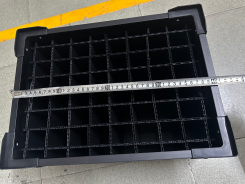
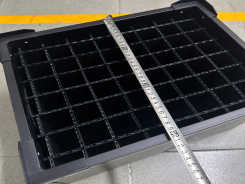
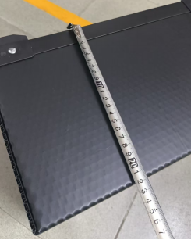
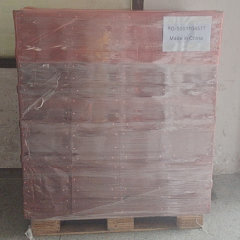
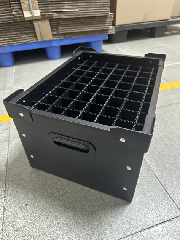
Below is a recent ESD honeycomb board tote box we produced for a French electronics client — 400×300×220 mm with precision grid dividers, rivet-reinforced corners, and die-cut handles.