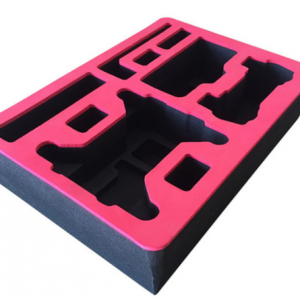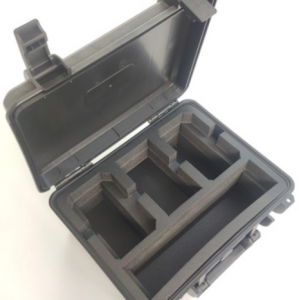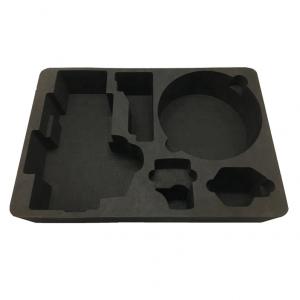

Both XLPE and EVA foam can be formulated with ESD properties, but they serve different packaging needs. This guide gives procurement engineers and packaging designers a practical framework for choosing the right material — based on real project data from Yufa Polymer's manufacturing floor.
Why Material Selection Matters More Than You Think
When specifying ESD foam packaging for electronic components, the conversation often starts and ends with surface resistance. As long as the foam falls within the 105–109 Ω static-dissipative range, some buyers treat the material choice as secondary.
In practice, the base foam material determines nearly everything else about the packaging's performance: how precisely cavities can be cut, how long a reusable tray will last, whether the foam will shed particles onto sensitive components, how much the packaging weighs, and ultimately what it costs. Choosing XLPE when EVA was the right answer — or vice versa — leads to over-engineered packaging, premature tray failure, or contamination risks that are expensive to fix downstream.
This guide provides a head-to-head comparison of the two most common ESD foam families used in electronics packaging: XLPE (cross-linked polyethylene) and EVA (ethylene-vinyl acetate). Both are closed-cell foams, both can be loaded with conductive fillers to achieve static-dissipative performance, and both are processed using die-cutting, CNC routing, and lamination. The differences lie in their mechanical properties, processing characteristics, and cost profiles.
Head-to-Head Comparison: ESD XLPE vs. ESD EVA Foam
| Property | ESD XLPE Foam | ESD EVA Foam |
|---|---|---|
| Full Name | Cross-linked polyethylene | Ethylene-vinyl acetate copolymer |
| Cell Structure | Very fine, uniform closed cells | Closed-cell; cell size varies with density/hardness |
| Typical Density Range | 25–200 kg/m³ | 40–200 kg/m³ |
| Practical ESD Density Floor | ~40 kg/m³ | ~50 kg/m³ |
| Hardness Range | Shore C 20°–45° (relatively soft) | Shore C 25°–70° (soft to rigid) |
| Surface Resistance (ESD) | 105–109 Ω | 105–109 Ω |
| Dust / Particle Generation | Very low | Low to moderate |
| Die-Cut Edge Quality | Excellent — smooth, clean walls | Good — may show slight texture at high hardness |
| Compression-Set Resistance | Moderate — better suited for single-use or light-cycle inserts | Good to excellent at Shore C 55°+ |
| Color Options (ESD grades) | Black only (carbon filler) | Black only (carbon filler) |
| Operating Temperature | −40°C to +80°C | −30°C to +70°C |
| Moisture Absorption | Near zero | Very low |
| Chemical Resistance | Excellent (inert to most solvents) | Good (some sensitivity to strong solvents) |
| Relative Material Cost | Higher | Lower to moderate |
| Common Processing | Die-cutting, CNC routing, lamination | Die-cutting, CNC routing, lamination, heat forming |
| Recyclability | Mechanically recyclable | Mechanically recyclable |
When to Choose ESD XLPE Foam
XLPE is the stronger choice when your packaging requirements are dominated by any of the following factors:
1. Ultra-Low Density / Minimum Weight
XLPE foam can be manufactured at lower densities than EVA while retaining a workable ESD range. In a recent project for a European electronics manufacturer, Yufa Polymer supplied custom ESD XLPE foam inserts at 40 kg/m³ — near the physical limit for stable static-dissipative performance. For companies shipping high volumes of individually packaged components, the weight savings at this density level translate directly into lower freight costs.
2. Precision Cavity Tolerances
XLPE's extremely uniform cell structure produces the cleanest die-cut edges of any common ESD foam. If your cavities need ±1 mm tolerances on cut profiles — for example, when packaging precision-ground nibs, optical components, or micro-connectors — XLPE will outperform EVA in cut-edge definition and repeatability.
3. Cleanroom or Low-Contamination Environments
XLPE generates fewer airborne particles than EVA during handling and component insertion/removal. For packaging that enters cleanroom or controlled-atmosphere environments, XLPE's low dust generation reduces the risk of particulate contamination on sensitive surfaces.
4. Wide Temperature Exposure
With an operating range extending to −40°C, XLPE handles cold-chain logistics and uncontrolled warehouse storage better than EVA, which can stiffen and become brittle below −30°C.
5. Chemical Inertness
XLPE does not off-gas corrosive compounds and resists degradation from most solvents and cleaning agents. This makes it the safer default for long-term storage applications where components may spend weeks or months in contact with the foam.
When to Choose ESD EVA Foam
EVA becomes the preferred material when the application emphasizes rigidity, durability, or cost efficiency:
1. Reusable Trays and Turnover Packaging
EVA's ability to reach Shore C 60° and above makes it the go-to material for assembly line trays that must endure hundreds or thousands of load/unload cycles. In a project for a global PCB assembly provider, Yufa Polymer designed a Shore C 60° ESD EVA foam tray that handles three different product configurations in a single 6-cavity design. The high hardness ensures cavity walls remain dimensionally stable over extended production runs.
2. Multi-Configuration or Universal-Fit Designs
When a single tray must accommodate components of different weights in the same cavity, the foam must be rigid enough that lighter components do not wobble while heavier ones do not deform the walls. EVA at Shore C 55°+ delivers this balance. Softer XLPE inserts would compress asymmetrically under varying loads.
3. Cost-Sensitive Programs
EVA foam is generally 15–30% less expensive than XLPE at comparable thickness and surface resistance. For large-scale tray programs — where hundreds or thousands of trays are produced per order — this cost difference becomes significant. If the application does not specifically require XLPE's low density or ultra-fine cell structure, EVA typically offers better value.
4. Multi-Layer Laminated Constructions
EVA bonds well with adhesive and with itself during thermal lamination. Multi-layer tray designs (such as the 3-layer construction described in our EVA case study) rely on strong, uniform interlayer bonding that EVA delivers reliably. While XLPE can also be laminated, EVA's bonding characteristics are more forgiving at production speeds.
5. Applications Requiring High Load-Bearing Capacity
Heavy components — such as power modules, metal housings, or stacked PCB assemblies — require foam with enough compressive strength to prevent bottoming out. EVA at Shore C 60° provides a firm platform that supports significant static loads without permanent deformation.
Decision Flowchart: XLPE or EVA?
Use this simplified decision framework to identify your starting-point material. Final material selection should always be validated with prototype testing.
Yufa Polymer's Design-to-Package Approach
Material selection is only one step in the ESD foam packaging design process. At Yufa Polymer, every project begins with a design consultation that considers the full set of requirements:
- Component geometry and weight — determining cavity dimensions, draft angles, and wall thicknesses.
- ESD sensitivity level — matching surface resistance to the component's ESD classification (HBM, CDM, or application-specific thresholds).
- Usage environment — single-use shipping insert vs. reusable turnover tray, indoor vs. outdoor storage, temperature extremes.
- Volume and cost targets — selecting the material and process combination that meets performance requirements at the right price point.
- Processing method — die-cutting for high-volume 2D profiles, CNC routing for complex 3D cavities, lamination/bonding for multi-layer constructions.
Based in Shenzhen, China, Yufa Polymer manufactures both ESD XLPE and ESD EVA foam products in-house, with die-cutting, CNC routing, and lamination/bonding capabilities under one roof. This means material changes and design iterations can happen fast — often within the same week — without coordinating across multiple vendors.
Summary: Quick Reference
| Choose This Material | When You Need |
|---|---|
| ESD XLPE Foam | Lowest weight, finest cell structure, cleanest die-cut edges, lowest dust, widest temperature range, maximum chemical inertness |
| ESD EVA Foam | High hardness (Shore C 50°+), reusable tray durability, multi-layer bonding, lower material cost, heavy-component support |
When the choice is not clear-cut, prototype both. Yufa Polymer routinely produces small-batch samples in both XLPE and EVA so that customers can test fit, feel, and ESD performance side by side before committing to production tooling.