
A Technical Guide to the Next Generation of ESD Packaging Materials
1. The Hidden Cost Your ESD Packaging May Be Adding to Your Supply Chain
In the electronics manufacturing industry, a widely underestimated problem quietly erodes margins: the hidden cost of packaging failure. Every year, electrostatic discharge (ESD) causes billions of dollars in component damage globally. But there is another cost that rarely appears on any single department’s budget: rework, returns, and line stoppages caused by packaging that cracks, deforms, or loses its ESD properties over time. These costs are diffused across procurement, quality, and logistics — making them difficult to track but impossible to ignore.
If you are currently using anti-static hollow polypropylene (PP) board or standard corrugated cardboard for ESD packaging, you may have already observed some of these symptoms:
• Boxes cracking at the edges or collapsing after just a few turnover cycles, forcing premature disposal
• Dividers and partitions warping or bending, allowing components to shift and collide during transit
• Surface resistance values drifting outside the acceptable range over time, failing customer audits
• Prohibitive mold tooling costs when you need a non-standard tray size for a specific product
These problems are not inevitable. A fundamentally different material is now solving them at the root — anti-static honeycomb board.
2. What Is Anti-Static Honeycomb Board? And Why Is It Structurally Different?
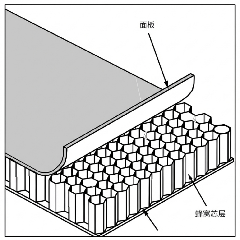
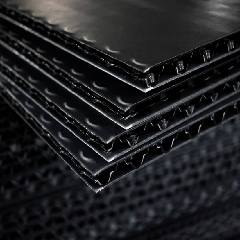
Anti-static honeycomb board uses a “face sheet – honeycomb core – face sheet” sandwich construction. The internal hexagonal honeycomb core is one of the most structurally efficient load-bearing geometries in engineering — the same principle used extensively in aerospace structural panels. At just 4mm thickness, honeycomb board achieves compression, bending, and impact resistance that far exceeds hollow PP board of equivalent gauge.
But the real differentiator is the reliability of its ESD performance. In the current market, very few products can pass both the surface resistance meter test and the dead-weight probe (hammer) test while consistently achieving 10⁴–10⁸Ω. This range is widely recognized as the optimal zone for ESD protection — dissipative enough to safely drain static charges from sensitive components, while not so conductive as to risk uncontrolled discharge events.
Key Specifications: Surface Resistance 10⁴–10⁸Ω | Thickness: 4mm | Standard Sheet: 2300 × 1200mm | Dual-instrument verified (surface resistance meter + dead-weight probe)
How It Compares to Conventional Materials
Deformation Resistance: Hollow PP board’s parallel flute structure is prone to collapse under sustained load. Honeycomb board’s hexagonal core distributes force evenly in all directions, delivering significantly superior structural stability.
ESD Longevity: Honeycomb board’s ESD properties are intrinsic to the material itself, remaining stable throughout the entire service life.
Weight and Logistics Cost: At equivalent strength levels, honeycomb board is 30–50% lighter than injection-molded alternatives, translating to meaningful freight savings at scale.
Sustainability: Paper-based and 100% recyclable, honeycomb board aligns with European ESG regulations and corporate sustainability targets — an increasingly non-negotiable procurement criterion.
3. Real-World Applications: How Honeycomb Board Solves Specific Industry Challenges
The following scenarios reflect actual use cases from our work with electronics manufacturers across Europe and Asia-Pacific. Each illustrates a specific pain point and a validated solution.
Scenario 1: Protecting Large Electronic Assemblies During Transit
“Our products are too large for standard ESD containers. Wooden crates are heavy and offer no static protection. Plastic cases are too expensive.” — A telecom equipment manufacturer, Asia-Pacific
For electronic assemblies in the 1200 × 800mm size range — server blades, base station modules, industrial control units — finding packaging that combines ESD protection, structural strength, and logistics efficiency is a persistent challenge.
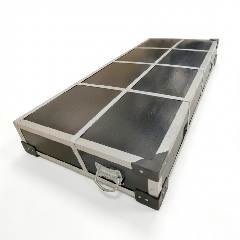
Solution: Large-format anti-static honeycomb board box (1200 × 800 × 250mm) with aluminum strip reinforcement. The aluminum framework provides structural rigidity for the oversized format, while the honeycomb board delivers lightweight ESD protection. The dimensions match the standard European pallet footprint, integrating seamlessly into existing logistics systems. Validated through multiple turnover cycles with no deformation and no ESD performance degradation.
Industries served: Telecom equipment, server and data center hardware, 5G base stations, large industrial control systems, aerospace electronic assemblies
Scenario 2: Small Component Classification and Turnover Durability
“The hollow PP board boxes we were using kept breaking down. The dividers warped, and components shifted during shipping.” — An automotive electronics supplier, Europe
In automotive electronics, semiconductor packaging, and consumer electronics, large quantities of small ESD-sensitive components require precise classification storage and safe turnover. Hollow PP board containers and dividers, while affordable initially, often fail to deliver the reuse cycles that justify their cost.
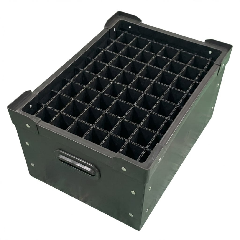
Solution: Anti-static honeycomb board box with custom die-cut dividers (e.g., 400 × 300 × 220mm with 48 cells, each 40.5 × 36mm). The rigid honeycomb dividers maintain precise cell dimensions through hundreds of insertion cycles. Box service life is significantly extended compared to hollow PP board, reducing total cost of ownership (TCO) despite a higher unit price.
Industries served: Automotive electronics (sensors, ECUs, ADAS modules), semiconductor packaging, medical electronics, precision connectors, optoelectronic devices
Scenario 3: Upgrading Internal Dividers Without Replacing the Entire Container
“Our boxes are fine, but the dividers inside keep failing — warping, jamming, letting layers of components collide.” — A semiconductor test and packaging facility
Dividers and partitions are the highest-wear consumable in any ESD packaging system. Many manufacturers have serviceable outer containers but struggle with dividers that lose dimensional accuracy after repeated use — particularly in double-layer storage configurations where inter-layer isolation is critical.
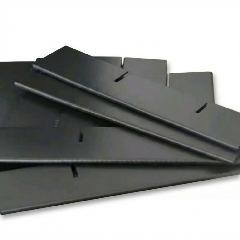
Solution: Double-layer anti-static honeycomb board dividers, fully custom-sized to fit existing containers. Can be purchased standalone or bundled with new boxes. The honeycomb material’s rigidity prevents warping through extended use, while the double-layer design doubles storage density within the same container footprint with complete inter-layer isolation.
Industries served: SMT assembly, semiconductor packaging and testing, precision connectors, optical modules and laser components, mobile device accessories.
Scenario 4: When No Standard Tray Fits Your Product
“We searched the entire market and couldn’t find an injection-molded tray in the size we needed. Custom molds were too expensive for our volume.” — A display panel manufacturer, Asia-Pacific
This is a more common problem than most people realize. Injection-molded ESD trays dominate the market, but every new size requires a custom mold — typically costing USD 7,000–20,000 — and only makes economic sense at high volumes. Companies with non-standard product dimensions, or those in product development phases with evolving specifications, are often forced to compromise with ill-fitting standard trays or absorb prohibitive tooling costs.
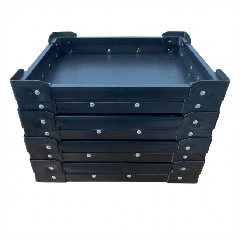
Solution: Stackable anti-static honeycomb board trays, custom-made to any dimension (e.g., 380 × 340 × 60mm). No mold investment required. Corner-edge design enables stable stacking. Load capacity ≥16kg meets industrial requirements. Small batch orders are economically viable, with lead times far shorter than injection molding.
Industries served: Display panel manufacturing (LCD/OLED), tablet and laptop assembly, mid-size PCB manufacturing and testing, photovoltaic cell sorting
Scenario 5: ESD Trays for Automated Production Lines
“Our line is fully automated. Trays must be completely flat on top and bottom — no raised edges. But finding an ESD tray that meets this requirement is nearly impossible.” — An automated production line operator
As Industry 4.0 transforms manufacturing, automated production lines impose fundamentally different requirements on component trays compared to manual handling. Surfaces must be flush to work with conveyor belt systems. Top surfaces must be flat for robotic arm gripping and positioning. Bottom surfaces must have no protrusions that could cause jamming. And in cleanroom environments, crevice-free designs are essential to minimize particle accumulation. Finding trays that satisfy all of these constraints while also providing ESD protection has been a significant gap in the market.
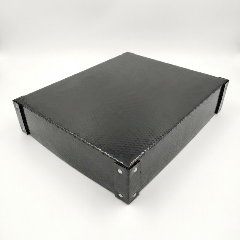
Solution: Flush-edge anti-static honeycomb board tray with completely flat top and bottom surfaces. This product required multiple design iterations to achieve structural integrity without any protruding edges — a seemingly simple requirement that proves technically challenging. The result seamlessly integrates with conveyor systems and robotic arms while maintaining full ESD compliance.
Industries served: Automated electronics production lines, semiconductor front-end processes, display panel cleanrooms, precision optical manufacturing, laser cutting and precision machining workpiece transfer.
4. Decision Guide: When Should You Consider Switching to Honeycomb Board?
Not every packaging scenario calls for a material change. However, if any of the following conditions apply to your operation, anti-static honeycomb board deserves serious evaluation:
• Your packaging needs to survive multiple turnover cycles, but current materials are not lasting as long as expected
• Your product dimensions are non-standard, and injection mold tooling costs are difficult to justify at your volumes
• Customer audits require stable, verifiable ESD performance, and your current packaging shows inconsistent readings
• You are looking for lighter-weight solutions to reduce freight costs across your supply chain
• Your organization has ESG commitments that require recyclable packaging materials
• Your automated production lines need trays with specific structural requirements (e.g., flush surfaces) that are not available in standard injection-molded formats
If any of these resonate with your situation, the material is worth testing. We provide complimentary sample evaluation services, allowing you to validate performance under your actual operating conditions before making any commitment.
5. Industry Outlook: The Macro Trends Driving ESD Packaging Material Upgrades
The global ESD packaging market is undergoing a structural transformation. Valued at approximately USD 4.4 billion in 2023 and projected to reach USD 7.0 billion by 2030 (CAGR 7.0%), the growth is being fueled by converging forces:
• Semiconductor nodes continue shrinking, making chips increasingly sensitive to ESD events and demanding more reliable packaging solutions
• Electric vehicles contain 3–5x more electronic components than conventional cars, creating explosive growth in automotive electronics ESD packaging demand
• Global 5G infrastructure deployment and data center expansion are generating massive demand for large-format electronic assembly transport
• European and North American ESG regulations are tightening, making recyclable packaging materials a hard procurement requirement rather than a preference
• Industrial automation upgrades are raising the bar for packaging precision, consistency, and equipment compatibility
Against this backdrop, anti-static honeycomb board — combining structural strength, stable ESD performance, lightweight design, mold-free customization, and full recyclability — is emerging as the material of choice for forward-thinking manufacturers. Whether upgrading internal dividers and liners or commissioning entirely new container and tray systems, honeycomb board offers a path worth exploring.
About Us
We are one of the few manufacturers with proprietary technology for 4mm anti-static honeycomb board, verified through dual-instrument testing (surface resistance meter and dead-weight probe) to consistently achieve 10⁴–10⁸Ω. We offer both standard sheet material (2300 × 1200 × 4mm) and fully customized product solutions, serving electronics manufacturers across Europe, Asia-Pacific, and beyond.
Contact us for complimentary samples and technical consultation.